Parking Allocation Software
November 19, 2026
28
Parking Allocation Software for Builders: How We Digitized Residential Parking with Workflow Automation & AI
Managing parking allocation in a large residential real estate project can become complicated when multiple buildings, flats, parking floors, customers and internal departments are involved.
The existing process depended heavily on Excel sheets, parking drawings, manual documents and departmental follow-ups.
Whenever a parking request was received, teams had to manually check the flat details, identify an appropriate parking space, verify availability and coordinate with different departments for approval.
This created several operational problems.
Parking availability was not available through one centralized system. Teams had to refer to different records and drawings to understand which parking spaces were available or already allocated.
As the number of requests increased, maintaining accurate parking information became more difficult and increased the possibility of allocation conflicts.
Another major challenge was the approval process.
A parking request needed to move between different teams such as Sales/CCD, Admin, Site Team and Accounts. Because much of this coordination depended on manual follow-ups, management could not easily identify:
Where a parking request was currently pending
Which department was responsible for the next action
How long a request had been pending
Which requests were delayed
How much time each department was taking
The organization also needed better visibility into the commercial side of parking allocation.
Parking sold amounts, advances, outstanding payments and supporting documents had to be tracked along with the actual parking allocation.
The final parking allotment documentation added another layer of manual work.
The overall challenge was therefore much bigger than simply identifying an empty parking space.
The real problem was:
How can we convert a manual, multi-department parking allocation process into one centralized and traceable digital workflow?
How We Solved the Problem
Netsol IT Solutions studied the complete parking allocation process and converted it into a centralized Parking Allocation Software workflow.
Instead of teams working through separate Excel sheets, parking drawings and manual follow-ups, the complete process was connected digitally.
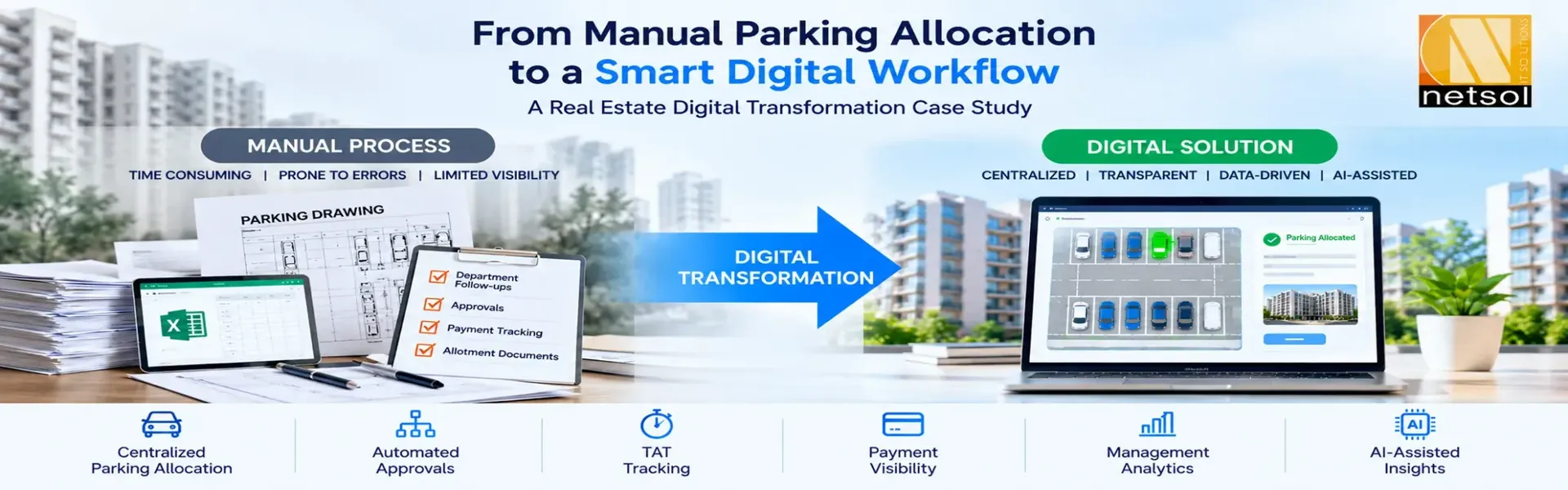
The transformation was:
Manual Parking Records → Centralized Parking Information
Parking Drawings → Visual Parking Selection
Manual Department Follow-ups → Digital Approval Workflow
Unknown Processing Delays → Department-Wise TAT Tracking
Separate Payment Records → Centralized Payment Tracking
Manual Allotment Process → Digital Parking Allotment Records
Multiple Reports → Centralized Management Visibility
The objective was not simply to digitize an existing form. It was to solve the operational gaps between the different departments involved in parking allocation.
Solving Parking Availability & Allocation Conflicts
One of the first problems was identifying the right available parking space.
We centralized parking information and connected it with the relevant building, flat, parking floor and vehicle requirements.
Teams could visually identify parking availability instead of repeatedly checking different drawings and records.
This helped create a more structured Digital Parking Allocation process and reduced dependency on manually maintained parking information.
Solving Departmental Follow-Ups
The next major problem was coordination.
Instead of manually calling or messaging different departments, the parking request was converted into a defined digital workflow.
The request could move through the required teams in sequence, with every stage digitally recorded.
This meant management could identify where a request was currently pending without asking multiple people for an update.
The manual follow-up problem became a Real Estate Workflow Automation process.
Solving the TAT Visibility Problem
One of the most important challenges was that management could see that a request was delayed, but identifying exactly where the delay happened was difficult.
We introduced department-wise TAT tracking.
The system records the time taken at different stages of the parking allocation process.
Management can therefore identify which requests are pending, how long they have been pending and which stage is causing the delay.
Requests exceeding the defined turnaround time can be highlighted for attention.
This changed the conversation from:
“Why has this parking request not been completed?”
to:
“This request has been pending at this stage beyond the expected TAT.”
That creates much clearer operational accountability.
Solving Parking Payment Visibility
Parking allocation also involved financial information.
To avoid maintaining allocation information and payment information separately, the process was connected with relevant parking payment records.
This gave management better visibility into sold amounts, advances received and outstanding amounts associated with parking allocation.
As a result, operational and commercial information could be reviewed together instead of being maintained through separate manual processes.
Solving Management Reporting with AI
Even after digitizing a process, management can still spend time opening dashboards, selecting filters and checking different reports.
We wanted to simplify this further.
The parking system was therefore prepared for AI-assisted data access through an MCP-based integration.
Instead of manually navigating several reports, an authorized management user can ask business questions in natural language.
For example:
“How many parking requests are pending?”
“Which requests have been pending for more than one day?”
“Which department has the highest TAT?”
“Show building-wise vacant parking.”
“What is the outstanding parking collection?”
“What needs management attention today?”
The objective of the AI integration is not to replace the underlying management system.
It provides authorized users with another way to access approved business information through natural-language questions.
This demonstrates a practical application of AI in Real Estate Software — using AI to make operational information easier for decision-makers to access.
The Result: From Manual Process to a Traceable Digital Workflow
The project transformed the parking allocation process from:
Excel + Parking Drawings + Manual Follow-Ups + Manual Approvals + Separate Payment Tracking
into:
Centralized Parking Allocation + Digital Workflow + TAT Monitoring + Payment Visibility + Management Analytics + AI-Assisted Data Access
The biggest improvement was not simply replacing Excel with software.
The real improvement was creating visibility and accountability across the complete parking allocation process.
Management can understand what is happening, teams have a structured process to follow, delayed requests can be identified, and parking information is maintained centrally.
This is how a carefully designed Parking Allocation Software can solve a real operational problem for residential real estate developers.
Does Your Real Estate Team Face a Similar Problem?
Many real estate organizations still manage important operational processes through a combination of Excel sheets, drawings, emails, WhatsApp messages and manual departmental follow-ups.
The challenge is often not the lack of data.
The challenge is that the data and workflow are spread across different people, departments and systems.
At Netsol IT Solutions Pvt. Ltd., we study these operational processes and develop custom software solutions that bring workflows, approvals, tracking, reporting and AI-assisted information access into a centralized system.
If your organization is facing a similar challenge with parking allocation, approval workflows or real estate process automation, talk to our team about how the process can be digitized.